Tuesday, May 10, 2011

Kiev, Ukraine

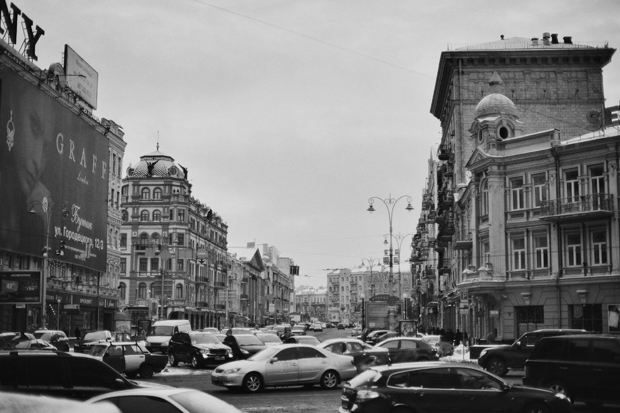
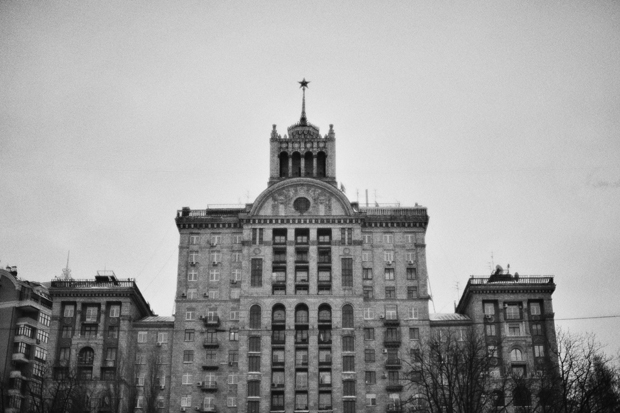
Kiev, Ukraine. We were pretty psyched to see this city. It is the largest city in Ukraine, the capital of the country, and an important city in Eastern Europe. We were extremely impressed. We hadn't heard very great things about Ukraine from our parents, and this city was just as beautifully constructed as other major European cities. Decorative buildings, wide streets, big parks, open plazas all define Kiev. Ah yes, and frigid cold winter.

We scored an apartment online for a really good price and felt like we were living in luxury. An apartment beats a hotel any day because there's a kitchen, washing machine, living room, etc. It was newly renovated and in the center of the city. There's no way you can get such a sweet deal in Western Europe (Paris & London were especially painful on the wallet). We felt like naturals stopping by the grocery store just around the corner from our place and buying kolbasa (sausage), smoked fish, tomatoes, onions, and bread. This is a classic Ukrainian snack or light meal. We also felt really cool watching Ukrainian TV and being able to understand it. There were so many instances we saw the news on some TV while traveling (in a airport, ferry, or hotel) and wished so badly we could understand what was being said. This time we could.

If you're looking for a European experience but don't have the money to shell out, Eastern Europe is where it's at.

- Julia


A statue of Lenin, creator of the Soviet Communist Party. Every city in Ukraine used to have his statue, but have all been replaced with Taras Shevchenko since the collapse of the Soviet Union. Somehow Lenin survived in Kiev.


Coffee and nalisniki (crepes filled with cheese) at a cafe.


Our sweet apartment in downtown Kiev (we didn't usually stay in nice places like this on our tight budget, so this was a big deal). Luxury.


A classic Ukrainian snack at our apartment... kolbasa (sausage), smoked fish, cheese, tomatoes, onions, and bread.

Monday, May 9, 2011

Got a story for a movie Part 2

Further to my blog Friday, once again, a friend of mine, Ted Bauman is looking for good ideas. Ted does movies for Hallmark Channel and Lifetime. You can imdb his credits at: 
http://www.imdb.com/name/nm0062185/

This is a departure from my regular blog but I thought maybe some of you might want to look at this. It's open to anyone, writers, non-writers, anyone who reads this blog. You might want to pass it on to others you think might be interested. 

And no, I don't get anything for this, just helping out a friend.

So here's what he's looking for.

What kind of stories:

Stories that are interesting and that could hold audience interest. Lifetime wants true stories "ripped from the headlines" and usually a woman in the lead role (but not always). They can come from books but not bestsellers as they are too expensive to buy. More obscure books and even out-of-print books are better. 

Holiday-themed stories are welcome, heart-felt themes and characters are in demand. 

The Main Character:

The main character usually has experienced some terrible event in her life, death, crime, infidelity, anything that allows her to overcome adversity to become a stronger individual. Teenagers or young adults can add to the story.

Finders Fee
 
A finder's fee of $3500 will be paid on 1st day of principal photography for true-life stories from newspapers or other sources and best efforts to give you an Associate Producer credit. Note that networks have ultimate veto power over screen credits.

A finder's fee  of $2000 for books and/or suggestions that lead to a movie. Credit can't be offered on these.

Keep in mind that TV movies for Lifetime and Hallmark are made for very little money, my Christmas movie was made for just under $1 million which 10 years ago would have been made for around $3.5 million. Networks pay anywhere from $350,000 to $750,000 for movies with occasional higher budgets.

You can email newspaper articles or links to stories directly to Ted at:

baumanent@gmail.com


Sunday, May 8, 2011

Secrets Resort in Montego Bay is HAUTE!

The Secret in Montego Bay, Jamaica is out—the new Secrets Resort is HAUTE! My most recent Jamaican getaway included a complimentary stay at this exciting new resort on behalf of the Jamaican Tourism Board. The moment that I stepped onto the property, I felt that this adults-only playground was exactly what I needed to relax and indulge.
The resort is tucked away on a half mile stretch of private beach where powdery white sand glistens against sun-kissed skin. The turquoise waters of the warm Caribbean Sea offer a stunning backdrop to what turned out to be one of my best stays ever in Jamaica.

My suite was on the Wild Orchid side (which is more contemporary compared with the more traditional St. James) with an ocean view. The minute that I walked into my room a full-size Jacuzzi tub with spa slippers and robe had my name written all over it. Once I figured how to man the controls without water flying all over the place it was heaven moving forward.


The brand’s motto is “Unlimited-Luxury® for All-Adult Passion” and I couldn’t agree more. It really is a great place to share your secrets. The Secrets Resort Montego Bay is just 20 minutes from the Montego Bay International Airport. The resort houses 350 suites, a full-services spa, theater, eight restaurants, a dance club and so much more. And the best part—you get it all for one all-inclusive price. Plus they serve cookies in the afternoon… what more could you ask for in an exotic playground?

And don’t forget the Spa by Pevonia… I had the most amazing treatments. My Papaya Pineapple pedicure was flawless, in fact, I have never had a polish so HAUTE! My hour-long massage was all that I needed to rejuvenate my mind and body after a busy travel season.

To learn more visit… http://www.secretsresorts.com/wildorchid/index.asp

Do you have a Secret resort that's HAUTE?

Friday, May 6, 2011

Got a story for a movie?

A producer friend of mine is looking for good ideas for TV movies, he's a real producer, currently in pre-production.  He's looking for movies that would be suitable for the big three, Lifetime, Hallmark and ABC Family. Canada has similar channels.

I'll post his blog Monday with more details.

Thursday, May 5, 2011

An Interview with Mom & Dad

This is not much of a travel post, but more of a personal post while we are covering Ukraine.

Some people have asked why we moved to America from Ukraine. I figured no one could answer better than my parents, and I was interested in the answers myself. So I conducted a little interview with them over Skype video chat.

One of the things that really surprised me was that my mom didn't even mention during the interview that she was pregnant throughout the 3 month immigration process! My little brother was born 2 months after we arrived in America, which means she gave birth in a new country, in a foreign hospital, not knowing the language, far from any family, not having much of anything for the baby. She's a tough woman. I can't imagine leaving the States forever with Yuriy and a bunch of kids in tow to a totally new country where nobody speaks a lick of English, no money, and our family and friends half way across the globe. I think it would be much easier for young people to make such a life-changing move. But especially in middle age with a family, it seems easier to just stay put where you are and ride it out, even if living conditions suck. I admire and respect my parents so much for their bravery.

This was all said in Ukrainian and translated by me into English.

- Julia

[Our family in Ukraine in 1989, shortly before leaving the country. That's little me in my mom's lap.]

Julia: Why did you decide to move to America with your family?
Dad: For religious freedom and better life.
Mom: We weren’t allowed to study. I wanted to be a doctor, or engineer, or nurse. You couldn’t get a bachelor degree if you didn’t belong to the Youth Communist Party (an organization everyone belonged to until 27 years old, then after 27 everyone joined the Communist Party). Even if you somehow finished a degree, you couldn’t get a job if they knew you were Christian. I ended up working as an accountant in a hospital.
Dad: We didn’t know the Soviet Union would break up. We were persecuted as Christians. We weren’t supposed to attend church and didn’t have the freedom to build a church building. We gathered in homes. We couldn’t get good jobs. We had simple jobs, even though we studied well in school. My father was in prison for 3 years for being Christian [when I was a kid]. The opportunity came up that wasn’t there before, and we didn’t know how long it would last, so we decided to go.
Mom: It was scary. Especially with little kids. You, Julia, were just one year old. It was Dad’s idea to go.
Dad: We were beat up at school and kicked out for our faith. We didn’t wear the special stars on our uniform ties. The teachers taught the students to laugh at Christians.

Julia: Who first gave you the idea to leave Ukraine?
Dad: During the early 70s was the first movement of Christians who were trying to escape, but the Soviet Union didn’t allow them to leave the country. When Gorbochov came into office, he allowed those who were persecuted, for political or religious reasons, to leave the Soviet Union. My brother Ivan wanted to go first and gave me the idea, but his wife really didn’t want to move, so we beat him to it (they came a couple years later).


Julia: Were either you or dad against the move?
Mom: At first I didn’t want to move because I was pregnant with Julia. I said give me peace. After the baby is born, I’ll think about it. Then you (Julia) were born and I gave in.

Julia: What was the process to immigrate to America from the USSR?
Dad: The USSR only allowed persecuted residents to leave. First of all, you had to have an invitation from Israel. The USSR didn’t allow us to leave to America. On the way to Israel, we stopped in Vienna and Rome for a period of time and a refugee organization there helped us move to America. Some people moved to Canada, some to Australia, but mostly to America.

[our family in Rome in 1989, on the way to America]

Julia: What were you worried about or afraid of before the move?
Dad: Worried about the language.
Mom: That we would miss home. If we would be comfortable here with our kids.
Dad: We were worried if we would ever be able to enter the USSR again. We left all our family there. When we left, we had to pay 800 rubles and reject our USSR citizenship. This was a major crime at the time, but in order to leave it was required. So we were considered criminals, and we were worried they’d never let us into our home country again.

Julia: During your first months in America, what did you love most about the country?
Dad: Stores. That there was everything in the stores. In Ukraine, we stood in line for food every week. There wasn’t enough food in the stores. If you needed butter or sausage, you had to stand in line for 2 hours. Ordinary butter was in deficit.
Mom: No meat in stores. No sausage in stores. No butter in stores. And some people didn’t even have the money.  And remember we lived in the city.
Julia: Where was all the food?
Mom: They sent it away to Russia.
Dad: We don’t know why there was no food.


Julia: What did you dislike during your first few months in America?
Dad: The buildings. They seemed very uncomfortable and ugly in comparison to Europe.
Mom: Mostly the apartments. We were living in apartments at first and really didn’t like them.
Dad: Stores were ugly too.
Mom: We didn’t see anything pretty for a long time. We also missed home a lot.
Dad: When we had a baby, David, [2 months after arriving in America] people told us to hide him. We were warned that criminals and bad people were everywhere in America. Also, people mowed the lawns on Sundays and on Easter.
Mom: This was incredible to us! Everyone in Ukraine (even Communists/atheists) cleaned and prepared for Easter. Cooked food, cleaned up their yards… everything in preparation for Easter. You would never find someone mowing their lawn or working on Easter.

[our family fresh in America in 1990 with a new baby brother]

Julia: In hindsight, are you glad that you and Dad made the move to America 21 years ago?
Mom & Dad: Yes [without hesitation].
Mom: We are happy for our kids. They can study here. Even though you can study there nowadays, but its easier and better here.
Dad: When you weigh the pros and cons, we are glad we are here. When we moved, we had free churches in America. You just felt more free and easy. We could breathe easier. When the Soviet Union collapsed, the economy was terrible, in ’91, ’92, ’93, and we missed all of it.  
Mom: At that time there was nothing in stores.
Dad: Back in the USSR, Christians were constantly afraid that they would be put in jail or sent to Siberia. Here [in America] that fear no longer existed. Many people we knew were in jail for 5 years and then sent to Siberia for 10 years. We know people who are now in America who came from their exile in Siberia [for their Christian faith].

[with my Mom & Dad today... well, at our recent wedding]

Julia: If you knew the Soviet Union would crumble in a couple years, would you have moved?
Mom: Probably not.

Julia: Why did people move to America after the collapse of the USSR anyway? (Yuriy’s family moved in 1992)
Dad: The economy was in shambles. Everything was uncertain and bad for a long time. Crime was up. People didn’t have anything to live for. People stole each other’s stuff. There were people who required money or they would do harm to your home, business, or even kill you. People in Ukraine didn’t know if the Communists would gain control again. They expected the worst.

Stealing Characters

                 
                   "My own little postage stamp of native soil"
                                                         - William Faulkner

Since last Thursday, I came out of my "writer's block" by following the rules I set down for my students when I taught screenwriting at UCLA extension (that's another blog, somewhere in the past).

If I would have followed it earlier I wouldn't have wasted 2 weeks in fumbling around looking for a story for the Christmas script. So what was my great discovery? 

I was making the mistake of making it up. Making up the characters and the situations. Very hard to do. At least for me. So I went back to the drawing board and realized what I had done in the past and what I had to do now.

I had to steal characters. 

And I don't mean from other movies. What I mean is that I have found, and this works great for me,  that using real people helps me create a story around them as well as subplots. It serves as a launching pad for a rich and 3-dimensional character.

Nice words to say, but doesn't every writer do that? I don't know, some writers are very secretive about their process. Not only do I not keep any secrets, I spelled out in my classes and in this blog how I write, what I write and why I write.

So what do I mean when I say I steal characters and real stories? I look around me and find real people, friends, strangers, anyone that might be interesting at that moment. Or someone from the past. Lots of people in the past. Way better than making them up.

Take Ghostkeeper 2, besides the characters from the first movie, I "created" two new characters, the Australian girl and a Metis  native Indian. The Australian girl was actually based on someone who worked at the hotel and was traveling the world. Although I never met her I had the beginning of a good character, even used the same name.

Then I added pieces of other mountain girls I have known when I lived in the Rockies. And in short time I had a great 3-dimensional character. 


The young Metis was actually based on a Native Indian I know in Canada, and it was a she not a he. I combined her personality with another Native Indian I knew who was a man and now had the makings of a real character.

Naturally the actors will hopefully add their own take but at least they are getting descriptions of parts of real live people, not pale made-up characters.

Ironically it took me years to learn this; I didn't know it when I made Ghostkeeper, that was my second ever screenplay. The first was awful. I have it but never show it to anyone.

It was all because of Syd Field. Most of you know who he is, arguably the first screenwriting guru who found a way to make tons of money by giving seminars. Syd always said you created a character by creating a map of interior and exterior forces including a biography and internal conflicts.

But doing all this I never really got a real character. I got a technical character. Boring as hell.

Who cares. Pretty lame stuff.

One of my first real screenplays was about a woman who was  a recovering druggie who goes back to her hometown to confront her father. I based the character on three real people. First was a development executive I knew who was an alcoholic but who gave me the best notes on a screenplay I ever had. And then I added a bit of another female film exec and her particular traits.

And the third person was me.

Yep. Me. My part was to provide the last bit of character to the other two, someone who wants to basically confront their father. I didn't have the baggage that the screenplay character had, just arguments with my dad. Father and son stuff.

And it worked.

The expression at the beginning from Faulkner, one of America's best novelists, refers to the fact that all  he wrote were stories based on the combinations of people in his little town of Oxford in Mississippi. In short, he didn't need to travel anywhere in order to find stories. He lived and died in the town.

And his books sold all over the world.

So much for Syd. Read Faulkner instead. Or even better, look around your town, or your block or your street. They're all there.

Every type of human being.


Wednesday, May 4, 2011

My Home in Rivne

On our last day in Rivne, Ukraine, our host Luda (my dad's cousin) and her son-in-law drove us to the special parts of the city. First we made a stop at the house where my family lived and where I spent the first year of my life before moving to America. The owners have built onto the house and it has changed much in the last 21 years since we left it. Of course, I had no memory of it, so I didn't recognize anything but the street address that I had heard so often from my parents-- 22 Шнанiвський Провулок.

Afterward, we drove past the place where my mom used to work, then out of the city into a nearby village called Городок where my mom's brother and sister and their families live to this day. Most of my aunts and uncles and even my grandparents have all moved to America in that last couple decades, but a few unfamiliar aunts, uncles, and cousins stayed behind. This was my first time meeting them. 

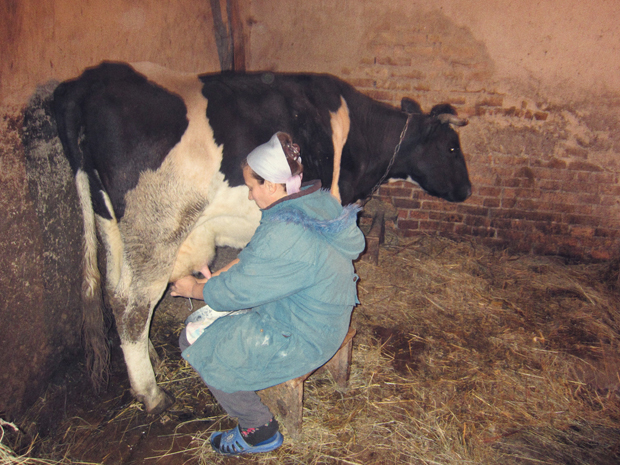
It was strange to see this woman halfway across the world who I've never met before, and who amazingly looks so much like my mom. I always take notice of people's hands and feet, and her's resembled my mom's so much. She's younger than my mom, but appears older. I guess it says something about the difference in their lifestyles. As we sat around in the living room chatting, the energy suddenly shut off (for no more than an hour) and my cousins lit some candles. Apparently this is how the village conserves energy daily in the winter and they have no say about it. We explored a small shed housing their pigs and a big cow named Martha. Then I watched my aunt milk the cow, something I've never seen before. She said all the neighbor's buy her milk because it's the best and she doesn't have enough to go around. The bathroom was an outhouse in the snow. It was so strange to see how differently my mom's siblings live. Our lifestyles were exactly alike at one point. Then we immigrated to America, and our lives became more and more different with time. I imagined what we would be like and how we would be living if my parents had never made the decision to move. 

- Julia

P.S. An interview with my parents coming tomorrow.

Me standing outside the house where I spent the first year of my life in Rivne.
This is a glimpse of the same house when we lived there, shortly before we left to America in 1989 (that's me in the stroller).
Looking down the street on which our house stands. 
My mom's sister, Galina, and her family (new cousins to me!).
The family animals in the shed behind the house.
I got my aunt to share her photo albums with me, and discovered some old photos of my parents, aunts,  uncles, and grandparents that I couldn't resist snapping with my camera.
My parents and my oldest sister, Natalia (now 28).
These photos are from the mid-80s in Ukraine. Don't they look so much older in comparison with American photos from that time?? Color photographs were so rare.